The Bridge to Reality: Why Prototyping is Essential
The journey of any brilliant idea, from an initial spark in a brainstorming session to a viable market product, is fraught with assumptions, risks, and countless potential points of failure that must be systematically addressed.
Relying solely on internal confidence or the theoretical elegance of a solution is a fool’s errand, as history is littered with commercially unsuccessful products that were technically sound but failed to meet real user needs.
This is precisely why Prototyping and Testing emerge as the most critical, non-negotiable phases in the entire innovation lifecycle, serving as the essential bridge between abstract concept and tangible market validation.
These processes allow innovators to quickly and cheaply transform hypothetical concepts into physical or digital artifacts that can be placed directly in front of real users, enabling rapid feedback loops that reveal flaws and confirm market fit.
By embracing a culture of continuous testing, organizations effectively minimize the devastating cost associated with launching a full-scale product only to discover a fatal flaw that could have been identified on a napkin or a simple wireframe months earlier.
Mastering these validation techniques ensures that resources are always deployed with maximal efficiency, guaranteeing that the final investment is channeled toward solutions that customers genuinely need and are willing to pay for.
Defining Prototyping and the Testing Mandate

Prototyping is the process of building early, experimental, and simplified versions of a product, service, or feature to quickly test concepts and assumptions.
A prototype is fundamentally a learning tool, designed to answer specific questions about the solution’s feasibility, usability, or desirability.
Testing is the subsequent, crucial activity of placing that prototype in front of target users under realistic conditions to gather validated feedback and measure its performance against key metrics.
The mandate of testing is rooted in the principle of validated learning: proving that the hypothesis behind an idea—that a particular solution will solve a specific customer problem—is actually true in the real world.
Together, prototyping and testing form a powerful, iterative cycle where speed is prioritized over perfection. The core mantra is “Fail Fast, Learn Faster,” accepting that quick failures on small-scale prototypes are essential steps toward discovering the ultimate successful solution.
This structured process eliminates guesswork, anchoring the innovation journey in objective, observable user behavior.
I. Levels of Fidelity: The Prototype Spectrum
Prototypes exist across a broad spectrum of fidelity, from the very basic and inexpensive to the near-final, fully functional artifact.
Innovators strategically choose the appropriate level of fidelity based on the specific question they are trying to answer at that moment.
A. Low-Fidelity Prototypes
These are the simplest, fastest, and cheapest versions, primarily used to test the core concept and flow with minimal investment.
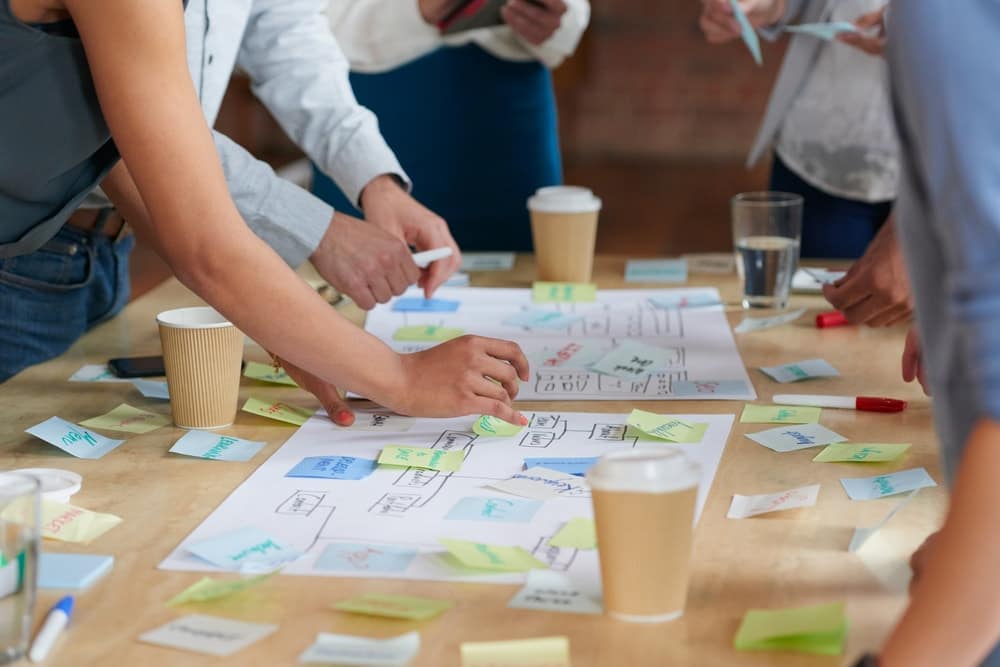
- Sketching and Paper Prototypes: Rough drawings on paper or whiteboards used to visualize the user flow, screen layouts, or basic physical form. These are ideal for testing sequence and logic.
- Wireframes: Basic structural blueprints for digital interfaces, often created with simple digital tools, focusing purely on content, information hierarchy, and functionality, devoid of design aesthetics.
- Storyboards: A series of sequential drawings or images used to illustrate how the user will interact with the product or service over time, emphasizing the experience and context of use.
B. Mid-Fidelity Prototypes
These prototypes begin to look and feel more like the final product, primarily used to test usability and interaction design.
- Digital Mock-ups: Created using dedicated design software (like Figma or Sketch), these include actual colors, fonts, and visual branding, but still lack back-end functionality.
- Clickable Prototypes: Interactive mock-ups where users can click buttons and navigate between screens, simulating the actual experience to test the fluidity and intuitiveness of the user interface (UI).
- Physical Models (Foam/Cardboard): Rough physical assemblies used to test ergonomics, size, balance, and how a user might physically handle the product.
C. High-Fidelity Prototypes
These are the most expensive and time-consuming prototypes, used late in the process to test technical feasibility and final user acceptance before mass production.
- Fully Functional Beta Products: Near-final versions of hardware or software that have all core features and are tested by a large group of “beta” users under real-world conditions.
- Proof-of-Concept (POC) Hardware: Working technical rigs designed solely to prove that a difficult engineering challenge (e.g., a new battery technology, a specialized sensor) can, in fact, be manufactured and function as intended.
- Pilot Programs: Deploying the service or product to a small, contained market segment to test the entire business model—including delivery, pricing, and support—at a small scale.
II. Strategic Testing Methods for Validation
Testing must be systematic and designed to answer specific, high-stakes questions about the innovation. Different questions require different testing approaches.
A. Usability Testing
Focuses on how easy and intuitive the product is to use, identifying roadblocks and areas of user confusion.
- Think-Aloud Protocols: Participants are asked to verbalize their thoughts, expectations, and frustrations aloud as they navigate a prototype or complete a defined task, providing rich qualitative data.
- Task Success Rate: Measuring the percentage of users who successfully complete a defined set of tasks using the prototype, quickly identifying design flaws that prevent goal completion.
- Eye Tracking/Heatmaps: Utilizing technology to visually map where a user’s attention is focused on a screen, revealing ignored content or confusing visual pathways.
B. A/B Testing (Split Testing)
Used to objectively compare two versions of a product, feature, or message to see which performs better against a measurable metric (e.g., conversion rate, click-through rate).
- Hypothesis Formulation: Clearly defining the expected outcome before the test begins (e.g., “Changing the button color from blue to green will increase click-throughs by 5%”).
- Random Assignment: Randomly exposing equal segments of the target population to Version A and Version B simultaneously to eliminate external variables.
- Statistical Significance: Running the test long enough and with a large enough sample size to ensure the observed difference in performance is reliable and not due to chance.
C. Technical Feasibility Testing
Focuses on proving that the underlying technology and engineering can reliably deliver the promised functionality at scale.
- Load Testing: Subjecting the prototype (e.g., a new application server) to extreme user volumes or data loads to determine its capacity limits and identify potential failure points.
- Stress Testing: Pushing the physical prototype (e.g., a new material or mechanism) beyond its specified operating limits to understand its durability and ultimate failure threshold.
- Integration Testing: Verifying that the prototype or new module works seamlessly and correctly with the company’s existing legacy systems and external APIs.
III. The Minimum Viable Product (MVP) and Validation

The Minimum Viable Product (MVP) is the ultimate prototyping strategy for entrepreneurs, representing the smallest possible functional product built to maximize learning and minimize development time.
A. The Purpose of the MVP
The MVP is not a poorly made product; it is a highly focused artifact designed to test the core value hypothesis in the fastest way possible.
- Risk Reduction: The MVP’s primary job is to prove or disprove the riskiest assumption of the business model before committing large-scale capital to full development.
- Early Adopter Engagement: It serves as a tool to engage the most eager, passionate customers—the early adopters—whose feedback is invaluable for shaping the next iteration.
- Establishing the Feedback Loop: Successfully launching an MVP immediately establishes the crucial Build-Measure-Learn feedback loop that drives the Lean Startup methodology.
B. Techniques for Creating and Testing MVPs
Entrepreneurs use resourceful, non-traditional methods to simulate the final product experience without actually building the entire final solution.
- Concierge MVP: The service is delivered manually by humans (e.g., the founder performs the service personally) rather than automated technology, allowing the team to learn deeply about the customer journey before investing in code.
- “Fake Door” Testing: Creating a button or landing page for a feature that doesn’t yet exist to gauge customer demand (measured by the click-through rate), validating desirability before any development begins.
- Wizard of Oz MVP: The user believes they are interacting with a fully functional, automated system, but the back-end functionality is actually being performed manually by the team (a hidden human operator).
IV. From Learning to Scaling: The Pivot Decision
The testing phase is designed to yield critical data that forces a crucial strategic decision: whether to continue with the current plan or fundamentally change direction.
A. Analyzing the Validation Metrics
Metrics gathered during testing must be focused on validated learning—data that proves a causal link between the product and user behavior—rather than vanity metrics.
- Customer Activation: Tracking the percentage of users who successfully move from the initial sign-up to experiencing the core “Aha!” moment of the product’s value.
- Retention/Churn Rate: Measuring the rate at which users continue to use the product over time, the ultimate indicator of true product-market fit.
- Monetary Value: Tracking metrics like Customer Lifetime Value (CLV) and Customer Acquisition Cost (CAC) to prove the financial sustainability of the validated solution.
B. The Strategic Pivot
When testing shows that the core hypothesis is flawed, the organization must exercise the discipline to pivot, fundamentally changing one or more elements of the business model based on the painful lessons learned.
- Customer Segment Pivot: Realizing the product solves a problem, but for a completely different target audience than originally intended.
- Zoom-In/Zoom-Out Pivot: Realizing that a single feature of the product is actually the full product (Zoom-In) or that the core product is merely one feature of a much larger, necessary platform (Zoom-Out).
- Technology Pivot: Realizing that the current technical architecture is non-scalable or too expensive, requiring a switch to a fundamentally different underlying technology.
The Indispensable Role of Continuous Validation
The commitment to Prototyping and Testing is the single most effective organizational safeguard against the colossal financial and reputational risk of market failure.
By embracing low-fidelity tools early and utilizing rigorous, measurable testing methodologies throughout the development cycle, innovators move their decisions from the realm of personal opinion to the certainty of validated user data.
This creates a culture where every investment is justified by real-world evidence, ensuring that resources are maximized and waste is aggressively minimized.
Ultimately, the successful organization is the one that views its entire innovation pipeline as a perpetual testing lab, where the creation of the final, scalable product is merely the logical consequence of a long series of well-executed, strategic experiments and continuous customer feedback loops.
Prototyping and testing are essential for bridging the gap between an abstract idea and a commercially viable product.
The process prioritizes speed and low cost, embracing the principle of “Fail Fast, Learn Faster.” Innovators use a spectrum of prototype fidelity, from simple paper sketches to fully functional beta versions, to answer specific, staged questions.
Usability Testing and A/B Testing are crucial methodologies for gathering objective, validated data on user behavior and preference.
The Minimum Viable Product (MVP) is the ultimate prototyping tool designed to maximize learning and minimize resource waste.
Rigorous analysis of testing metrics leads to the crucial Pivot or Persevere decision that guides the final stages of scaling.