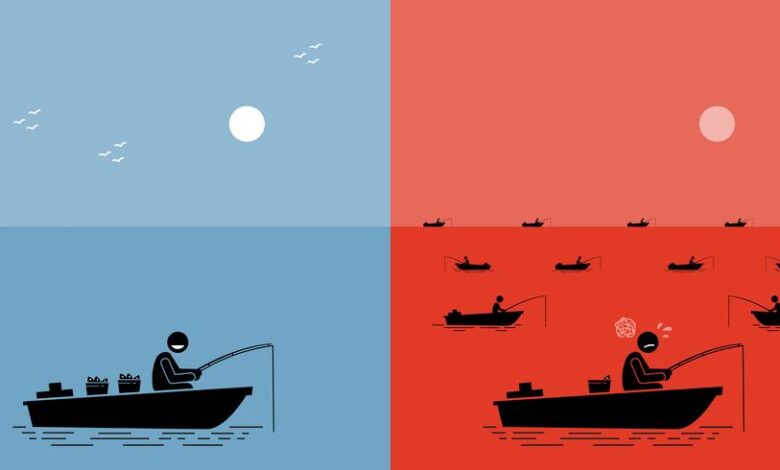
For generations, the conventional wisdom guiding business strategy has been deeply rooted in the concept of competition, where firms focus their primary efforts on fiercely battling rivals for marginal gains within existing, well-defined industry boundaries, a zero-sum contest often referred to as the “Red Ocean” where companies must continually fight to secure a larger piece of a shrinking or stagnated pie, driving down margins and increasing the pressure on prices and costs.
This relentless and often bloody competition, characterized by incremental differentiation and aggressive positioning against competitors, inevitably leads to market saturation, forcing participants into a destructive cycle of price wars and defensive maneuvering that ultimately benefits neither the companies nor their customers, draining the energy and resources that could otherwise be dedicated to genuine value creation.
The traditional strategic model dictates that competitive advantage is achieved through either cost leadership or product differentiation, but this mindset fundamentally accepts the market boundaries as fixed constraints rather than malleable constructs subject to radical redefinition, limiting the scope of strategic ambition and innovation.
The revolutionary Blue Ocean Strategy, pioneered by W. Chan Kim and Renée Mauborgne, rejects this foundational premise of competition entirely, proposing instead a holistic approach that simultaneously pursues high differentiation and low cost by identifying or creating entirely new, uncontested market spaces, thereby making the competition irrelevant and unlocking enormous, untapped demand.
Pillar 1: Understanding Red Oceans vs. Blue Oceans
Defining the strategic dichotomy and the foundational shift required for new market creation.
A. The Red Ocean Environment
The traditional, competition-focused marketplace.
-
Defining the Space: Red Oceans represent all the industries in existence today, where market boundaries are well-known and accepted by all players.
-
Strategic Focus: The goal is to outperform rivals to capture a greater share of existing, established demand within the defined space.
-
Characteristics: Competition is intense, products become commodities, growth is incremental, and the environment is characterized by price wars and shrinking profits.
B. The Blue Ocean Environment
The strategy of uncontested market creation.
-
Defining the Space: Blue Oceans denote all the unknown market spaces—industries that do not exist yet or are created by fundamentally redefining existing ones.
-
Strategic Focus: The goal is to create entirely new demand and make the competition irrelevant by offering a leap in value to buyers.
-
Characteristics: Growth is rapid and profitable, the space is uncontested, the focus is on value innovation, and boundaries are continually expanding.
C. Value Innovation: The Cornerstone of Blue Ocean Strategy
The simultaneous pursuit of differentiation and low cost.
-
Challenging the Trade-off: Traditional strategy assumes a trade-off between value (differentiation) and cost(efficiency); you can have one, but not both.
-
The Goal: Value Innovation aims to simultaneously achieve high differentiation for the buyer while drastically lowering costs for the company.
-
Achieving Synergy: This is achieved by eliminating and reducing factors that the industry currently competes on (cost reduction) while raising and creating new factors that the industry has never offered (differentiation).
Pillar 2: The Four Actions Framework (ERRC)
The essential analytical tool used to reconstruct market elements and achieve Value Innovation.
A. Eliminate
Deciding which industry factors to remove entirely to save costs.
-
Question: Which of the factors that the industry takes for granted should be eliminated?
-
Goal: This action forces the company to stop investing in features or services that may historically be seen as necessary but no longer add significant value to the new customer segment.
-
Example: Cirque du Soleil famously eliminated expensive animal acts and celebrity performers—traditional, high-cost pillars of the circus industry—because modern audiences valued theatrical performance more.
B. Reduce
Determining which industry factors to diminish below the industry standard.
-
Question: Which factors should be reduced well below the industry standard to lower costs?
-
Goal: This challenges the company to lower the investment in features that are over-engineered or over-served by the current industry standards, reducing unnecessary complexity and cost.
-
Example: Yellow Tail wine reduced the complexity of wine terminology, aging claims, and vineyard prestige—factors that intimidate casual buyers—making the purchase decision simpler and cheaper.
C. Raise
Identifying which core industry factors should be enhanced above the current standard.
-
Question: Which factors should be raised well above the industry standard to increase buyer value?
-
Goal: This forces the company to invest selectively in existing features that truly delight buyers or solve pain points better than the competition.
-
Example: Netflix raised the convenience and quality of content delivery, moving far beyond the late fees and limited selection offered by traditional video rental stores.
D. Create
Discovering entirely new value elements never before offered by the industry.
-
Question: Which entirely new factors should be created that the industry has never offered?
-
Goal: This is the most crucial step, identifying unmet buyer needs and translating them into new, compelling value propositions that are the unique selling point of the Blue Ocean.
-
Example: Nintendo created new interactivity and group play (via motion controls) with the Wii, attracting non-traditional gamers who had never before considered buying a dedicated console.
Pillar 3: Analytical Tools for Blue Ocean Discovery

The strategic instruments used to visualize the market and identify new value frontiers.
A. The Strategy Canvas
A visual diagnostic tool for comparing current offerings and charting future value.
-
Definition: The Strategy Canvas is a visual graph that plots the performance of a company and its competitorsacross the key factors the industry competes on.
-
Value Curve: The line connecting a company’s performance points across these factors is its “Value Curve,”visually representing its strategic profile.
-
Blue Ocean Goal: The aim is to create a new Value Curve that dramatically diverges from the competitors’ curves, often resulting in an “L” shape or a unique profile, indicating successful differentiation and cost management.
B. The Six Paths Framework
Identifying systematic ways to look beyond existing industry boundaries.
-
Path 1: Look Across Alternative Industries: Don’t just compare against direct competitors; see why customers choose a non-industry alternative (e.g., Cirque du Soleil looking at theatre, not just other circuses).
-
Path 2: Look Across Strategic Groups: Analyze what causes customers to trade up or down between different tiers or segments within the same industry (e.g., luxury vs. budget airlines).
-
Path 3: Look Across the Chain of Buyers: Define the market by looking beyond the primary purchaser to the user, the influencer, or the financier, identifying their differing value needs.
-
Path 4: Look Across Complementary Offerings: Consider the entire ecosystem of products and services used before and after the purchase (e.g., looking at the hassle of setting up electronics after buying the device).
-
Path 5: Look Across Functional/Emotional Appeal: Determine if the industry primarily competes on utility (functional) or feeling (emotional), then try shifting the appeal to the opposite extreme.
-
Path 6: Look Across Time: Anticipate the direction of external trends (e.g., regulatory changes, new technology) and create a strategy to meet that future demand before the trend fully hits.
C. The Buyer Utility Map
Pinpointing pain points and maximizing the customer experience.
-
Identifying Utility Levers: The map analyzes six stages of the buyer experience (Purchase, Delivery, Use, Supplements, Maintenance, Disposal) against six utility levers (Productivity, Simplicity, Convenience, Risk, Fun/Image, Environmental Friendliness).
-
Identifying Pain Points: By charting where competitors focus their efforts, the company can visually identify the areas and stages of the buyer experience that are currently neglected or filled with hidden costs and hassles.
-
Unlocking Value: The goal is to focus Value Innovation efforts on the largest pain points identified on the map, translating those neglected areas into new, compelling buyer utility.
Pillar 4: Implementation and Organizational Alignment
Ensuring the company structure and culture can execute the new strategy effectively.
A. Overcoming Organizational Hurdles (Tipping Point Leadership)
Managing the human and political challenges of radical change.
-
Cognitive Hurdle: Convince managers and employees that radical change is necessary by making the “Red Ocean” problem visually clear and inescapable (e.g., showing them the Strategy Canvas).
-
Resource Hurdle: Since resources are finite, focus on concentrating resources on the factors being Risen and Created and systematically eliminating or reducing investment in the legacy factors.
-
Motivational Hurdle: Champion the change by focusing on the unfairness of the status quo and clearly communicating the benefit of the Blue Ocean to the people most affected by the change.
-
Political Hurdle: Isolate the internal opponents who benefit from the status quo and build a coalition with the major stakeholders who stand to gain from the new market space.
B. Integrating Execution and Strategy
Closing the gap between planning and action.
-
Fair Process: Ensure that the process used to create the Blue Ocean strategy is fair, meaning decisions are transparent, employees are heard, and the rationale is clearly explained.
-
Commitment and Trust: Fair process builds deep employee trust and commitment to the execution, ensuring the entire organization moves toward the new market space cohesively.
-
Project Focus: Blue Ocean projects should be managed as distinct, high-priority ventures with dedicated teams, shielding them from the inertia and politics of the legacy Red Ocean business units.
C. Aligning the Three Strategy Propositions
Ensuring the internal workings support the external value proposition.
-
Value Proposition: The external offering to the customers—what the new product/service is and how it provides a leap in value.
-
Profit Proposition: The internal model—how the company will make money at the new cost structure and pricing level.
-
People Proposition: The internal culture—how the company motivates and retains the talent required to sustain the new value and profit propositions (e.g., providing the right incentives for cross-functional collaboration).
Pillar 5: Sustainability and Renewal in Blue Oceans
Maintaining competitive advantage once the market space is established and attracting rivals.
A. Anticipating Red Ocean Drift
Recognizing when the Blue Ocean is starting to attract competition.
-
Imitation is Inevitable: Successful Blue Oceans will eventually attract imitators—companies that try to replicate the successful Value Curve or adapt the original idea.
-
Monitoring the Curve: Continuously monitor the Strategy Canvas to see if competitors’ Value Curves are beginning to converge with the pioneer’s, signaling a drift back toward a Red Ocean.
-
Proactive Innovation: Companies must not rest on initial success; they should proactively seek a second Blue Ocean strategy before the first one becomes saturated or commoditized.
B. Barriers to Imitation (Making the Ocean Deep)
Creating structural deterrents to keep competitors out longer.
-
Brand Equity and Trust: The pioneering company can build massive brand equity and consumer trust based on the new, compelling value proposition, making it difficult for imitators to compete on reputation alone.
-
Economies of Scale and Cost Advantage: By achieving massive scale quickly in the uncontested space, the pioneer can drive costs down further than latecomers can manage, creating a cost-structure barrier.
-
Ecosystem Lock-in: Creating an ecosystem of complementary products or services that revolve around the core Blue Ocean offering can lock in customers and deter rivals from offering a piecemeal imitation.
C. The Renewed Blue Ocean Search
Committing to the mindset of perpetual value creation.
-
Continuous ERRC Application: The Four Actions Framework should be applied continuously to the core business and adjacent industries, fostering a culture of perpetual value reconstruction.
-
Focus on Non-Customers: Always direct strategic attention toward the vast group of non-customers—those who currently refuse to buy the industry’s existing products—to identify their unmet needs for the next breakthrough.
-
Strategic Shift: The ultimate measure of success is not market share in the current space but the organization’s cultural shift from competitive fighting to value-based creation, making the Blue Ocean mindset the new normal.
Conclusion: The Ultimate Goal of Strategic Avoidance

The Blue Ocean Strategy fundamentally repositions the strategic focus of an organization, shifting the objective from merely beating competitors in crowded markets to the far more lucrative act of creating and capturing entirely new, uncontested demand.
This powerful methodology demands a cognitive leap, forcing leaders to reject the historical trade-off between high differentiation and low cost, instead pursuing both simultaneously through the discipline of Value Innovation.
The core of this transformative approach is the Four Actions Framework, a methodical tool that instructs companies on precisely what to Eliminate and Reduce to lower costs while simultaneously determining what to Raise and Create to achieve a massive leap in buyer utility.
Success relies heavily on strategic visualization tools like the Strategy Canvas, which clearly maps the current competitive landscape, and the Six Paths Framework, which systematically guides the organization beyond the rigid boundaries of the existing industry definition.
Implementation of a Blue Ocean Strategy requires bold “Tipping Point Leadership” to successfully navigate the internal political, cognitive, and motivational hurdles that inevitably accompany any radical organizational pivot away from the comfort of the status quo.
For long-term sustainability, the Blue Ocean pioneer must not become complacent but must proactively create structural barriers to imitation and continuously monitor its Value Curve for signs of convergence, committing to the search for the next uncontested market space.
Ultimately, by prioritizing the creation of new markets and making competition irrelevant, the Blue Ocean Strategy offers a comprehensive, systematic framework for companies to unlock explosive, profitable growth and fundamentally shape the future direction of their respective industries.